Crate Training a Australian Shepherd and Preventing Separation Anxiety
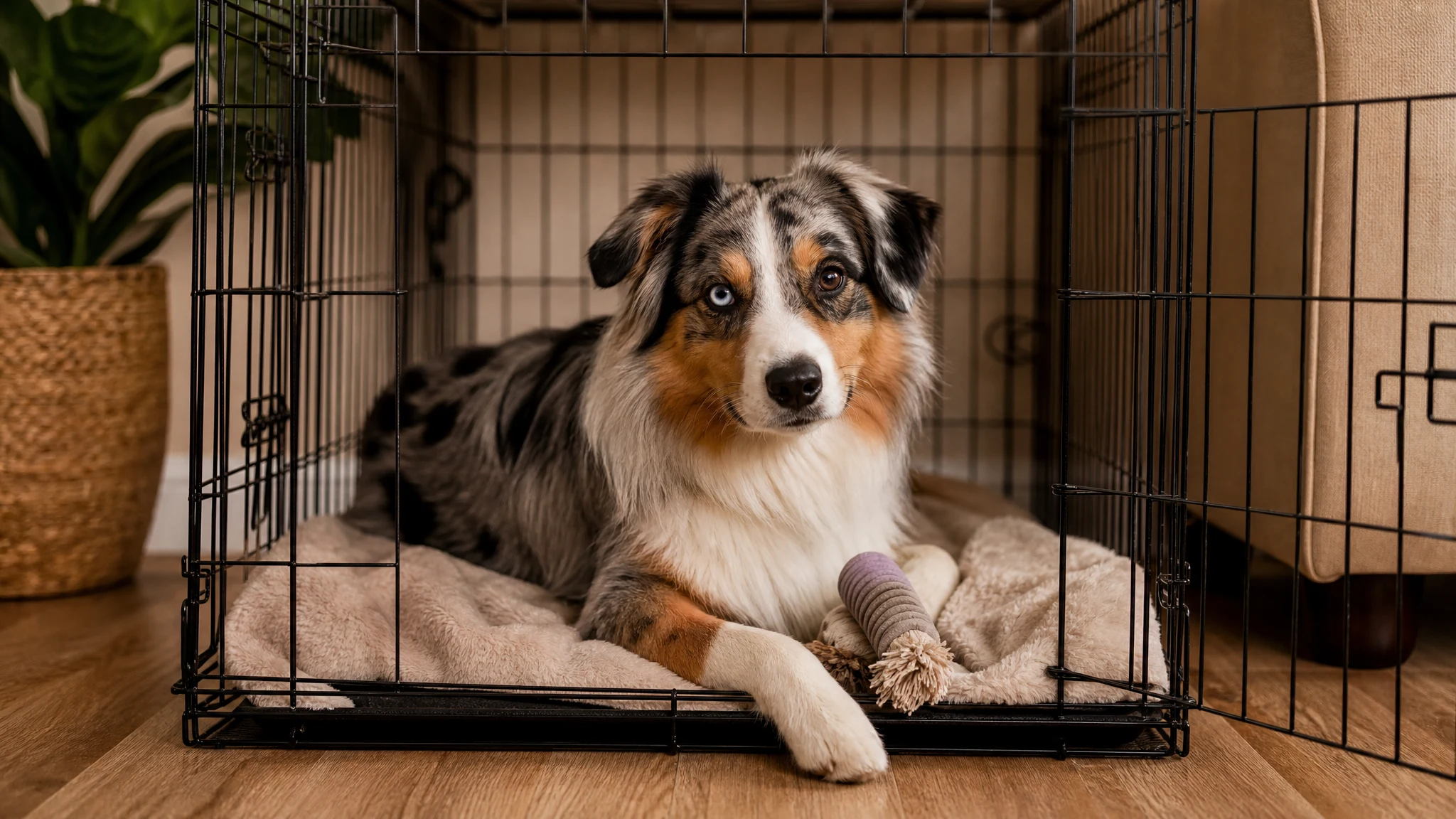
General training information. Every dog is an individual; for health or behavior concerns, see your veterinarian.
An Aussie that settles calmly in a crate is a pleasure to live with. One that panics when you leave the room is a hard day for everyone. The difference usually comes down to how the crate was introduced and how slowly alone time was built.
This guide walks through Australian Shepherd crate training from the first sniff to your first trip out of the house. It also covers the early signs of separation distress and when to call your veterinarian.
Why the crate matters for this breed
The United States Australian Shepherd Association (USASA), the breed's parent club, describes the Aussie as intelligent and eager to please, and says the breed is easily trained and easily housebroken. That is a good starting point for crate work.
USASA also describes a very active dog that needs a great deal of daily exercise to avoid boredom or frustration. It lists a strong herding instinct and a tendency to be territorial and protective of possessions among the breed's challenges. It names unmet needs as a frequent reason Aussies end up surrendered to rescue groups.
Put those together and the plan is clear. A crate works best as a calm, quiet place that follows exercise and mental work. It is not a place to store a bored dog. Individual dogs vary, so watch your own dog rather than assuming.
Materials you need
- A crate in the right size. See the sizing section below.
- A divider panel if you are buying one crate for a growing puppy.
- A washable mat or bed that your dog will not shred. Skip bedding until chewing is under control.
- Small, soft treats that your dog finds exciting.
- One or two safe chew or food-dispensing toys for crate time.
- A crate cover or light blanket, if your dog settles better with a dimmer space.
- A baby gate or exercise pen for a safe area outside the crate.
- A timer or notebook to track how long your dog stays calm.
Choosing the right crate size for an Aussie
Start with the dog's adult size. According to the USASA breed standard, males stand 20 to 23 inches and females 18 to 21 inches. USASA's breed overview gives weights of about 50 to 65 pounds for males and about 40 to 55 pounds for females.
The crate should let your dog stand without ducking, turn around easily and stretch out lying down. Too small is uncomfortable. Too big can make a puppy feel unsettled and may let a young dog use one end as a toilet.
Crate makers label sizes differently, so I will not name a single size for every Aussie. Check the sizing chart from the crate brand you are considering. Measure your dog's standing height and body length, then compare. If you have a puppy, ask your breeder or veterinarian about the likely adult size, and use a divider to shrink the space for now.
A puppy's growth is also a reason to buy a sturdy crate once rather than replacing several. A divider lets one crate cover several months.
Step-by-step: crate training your Australian Shepherd
Step 1: Set up a good spot
Place the crate in a room where the family spends time, such as the living room or a corner of the kitchen. Aussies are people-oriented dogs and a crate in a distant room can feel like punishment. Keep it away from heaters, direct sun and drafts.
Put the mat inside, leave the door tied open, and let your dog look around on their own terms.
Step 2: Make the crate a happy place
Toss a few treats near the crate. Then toss some just inside the door. Let your dog walk in, eat and walk out. Do not close the door and do not push your dog in.
Repeat this over several short sessions. Praise quietly when your dog chooses to step in. If your dog hesitates, go back to treats near the entrance and move slowly.
Step 3: Feed meals in the crate
Feed meals at the back of the open crate. Eating there builds a strong, positive link. Once your dog walks in eagerly, close the door while they eat, then open it the moment the bowl is empty.
Extend the closed-door time a little at a time. If your dog starts whining, you moved too fast. Drop back to the last easy step.
Step 4: Add a cue and calm duration
Pick a simple cue such as "crate" or "bed" and say it as your dog walks in. Reward with a treat and a chew. Sit nearby, read a book or look at your phone, and stay boring.
Build from a few seconds to a few minutes with the door shut. Reward only calm behavior. Open the door before your dog gets upset, not after. If you let them out in response to barking, they may learn that barking opens the door.
Step 5: Move around the room
Once your dog is relaxed with you sitting close, stand up, take a step away and come back. Then walk across the room. Then go to another room for a few seconds.
Aussies are bred to watch and respond to movement, so a dog may track every step you take. That is normal. Reward the moments when your dog lies down and lets you go.
Step 6: Practice short departures
Now pair the crate with brief, real exits. Give your dog a chew, close the door, and step outside for a very short time. Return before there is any fuss. Stay calm when you come back and do not make hellos dramatic.
Vary the length of these absences. Sometimes it is 30 seconds, sometimes a few minutes. Do not follow a fixed pattern, because predictable steps can make a dog wait for the next increase.
Step 7: Exercise first, then crate
Given USASA's note about this breed's exercise needs, a crate session goes better after a walk, sniffing time and a short training game. A tired, mentally satisfied dog finds it easier to settle.
Do not rely on exhausting a dog to fix anxious behavior. Hard exercise just before a long confinement is not a cure, and a dog that panics is not helped by being worn out. If your dog is distressed even after a good outing, treat that as information.
Step 8: Build longer alone time
Increase the time gradually over days and weeks. A useful rule is to raise the duration only after your dog has been calm at the current length several times in a row. If you see signs of stress, go back to an easier length and stay there for a while.
Practice leaving at different times of day and in different clothes. Pick up keys and put them down without leaving. This takes the drama out of the cues that predict your departure.
Preventing separation anxiety, not just crate protest
Crate training and separation anxiety are related but not the same. A dog can love a crate and still struggle when left alone, and a dog can fuss in a crate yet be fine alone in the house. Treat them as two skills.
- Teach independence early. Give your dog times each day when you are in view but not interacting, such as behind a gate.
- Keep leaving and returning low key. No long goodbyes or excited reunions.
- Provide daily mental work. Puzzle toys, scent games and short training sessions give a working-type dog something to do.
- Use the crate for rest, not as a default. A dog who spends most of the day confined is not learning calm, only waiting.
- Socialize with care. USASA's buyer checklist asks that breeders keep a puppy with littermates until at least 8 weeks of age and that the puppy be well socialized. Keep building on that with calm, positive experiences.
Signs of separation distress
Watch for patterns that happen mainly when you are gone or about to leave. Examples include:
- Continuous barking, howling or whining that does not ease
- Frantic scratching at doors, crate bars or windows
- Drooling, panting or pacing that begins as you get ready to leave
- Toileting indoors in a dog who is otherwise reliably housebroken
- Destroying items near exits
- Refusing food or treats when alone
- Injured teeth, gums or paws from chewing at the crate
A camera or recording app can show what happens after you leave. Many owners are surprised, either by a dog who settles fast or by one who struggles the whole time.
Only a professional can say what is causing these behaviors, so avoid labeling your dog yourself.
When to see a veterinarian
Call your veterinarian if distress is intense, if your dog hurts themselves, or if house soiling or other changes appear suddenly. Pain, medical problems and other causes can look like anxiety, and a vet visit rules those out.
Your veterinarian can also refer you to a veterinary behaviorist or a qualified trainer who uses reward-based methods in line with the American Veterinary Society of Animal Behavior (AVSAB). Please do not use shock, prong or choke collars, or punishment, to stop crate or alone-time protest. Those methods can make fear worse.
One note on medication. USASA's health program lists drug sensitivity (MDR1) among the conditions it tracks for the breed, and lists MDR1 testing as optional for its CHIC program. If your vet suggests any medication for anxiety, mention your dog's lineage and ask whether MDR1 testing makes sense. Never give any drug or supplement without your veterinarian's direction.
Tips for success
- Keep sessions short and end on a good note.
- Use the crate for naps and quiet time when you are home, so it is not only a sign you are leaving.
- Rotate chew items so they stay interesting.
- Take a few short breaks during the day if your schedule is long, or ask a trusted person to help.
- Keep a log so you can see progress over weeks instead of judging one hard day.
Common mistakes to avoid
- Using the crate as punishment. It should stay a safe, pleasant place.
- Rushing the steps. Most setbacks come from jumping ahead.
- Letting a dog out during a protest. Wait for a brief pause, then open the door.
- Skipping exercise and mental work. USASA says unmet needs lead many Aussies to rescue, so plan for them.
- Leaving unsafe items in the crate. Remove collars, tags and anything that could snag or be swallowed.
- Long confinement. A crate is not a substitute for company, a break or a place to toilet.
- Making big goodbyes. Your calm sets the tone.
What results to expect
Many Aussies learn to enter a crate willingly within a few weeks of steady, positive practice. Longer alone time often takes more weeks or months, and some dogs may need extra support. Progress is rarely a straight line.
With patient, reward-based training, you may find your dog settles faster, rests more easily and copes better with being alone. Results differ from dog to dog and depend on age, history and daily routine, so no outcome can be promised. If you are not seeing progress, speak with your veterinarian or a qualified behavior professional.
A final word
The Aussie's bright mind and eagerness to please work in your favor here. Take the crate slowly, pair it with plenty of exercise and mental work, and build alone time in small steps. If your dog shows real distress, ask for help early. It is kinder to your dog and usually easier on you.
Sources
- United States Australian Shepherd Association, The Australian Shepherd
- United States Australian Shepherd Association, Breed Standard
- United States Australian Shepherd Association, Buyers Checklist
- United States Australian Shepherd Association, Health & Genetics Program
- United States Australian Shepherd Association