Australian Shepherd Puppy Training Timeline: 8 Weeks to 2 Years
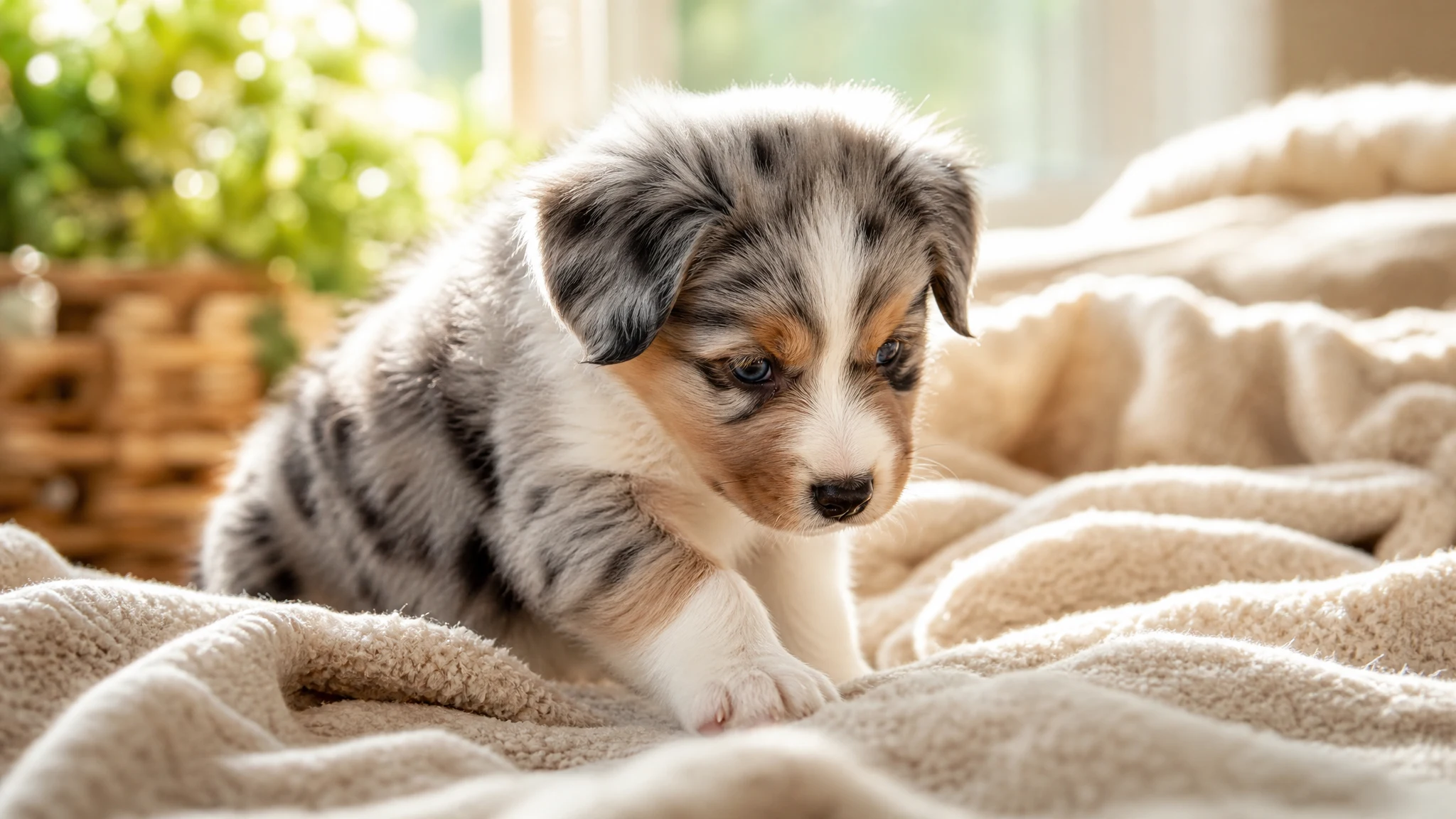
General training information. Every dog is an individual; for health or behavior concerns, see your veterinarian.
An Aussie puppy is bright, busy and always watching you. That is a gift when you train well and a headache when you do not. This guide walks through Australian Shepherd puppy training from the day you bring your puppy home until about the second birthday.
Think of it as a rough map, not a contract. Individual dogs vary, and a puppy that is ahead in one skill may be behind in another. Use the ages below as checkpoints, and adjust to the dog in front of you.
In this guide
- Key takeaways
- What makes Australian Shepherd training different
- Weeks 8 to 12: coming home and building routines
- Months 3 to 4: socialization, house training and bite inhibition
- Months 4 to 6: teething, focus and herding habits
- Months 6 to 12: adolescence
- Year 1 to 2: maturity
- A sample daily schedule
- Health, growth and joint care
- Sources
Key takeaways
- The United States Australian Shepherd Association (USASA), the breed's parent club, describes the Aussie as intelligent and eager to please, and says the breed is easily trained and easily housebroken.
- USASA also says the breed is very active and needs a great deal of daily exercise to avoid boredom or frustration. Training and exercise go together.
- USASA's buyer checklist asks that a puppy stay with littermates until at least 8 weeks and be well socialized. Your work starts where the breeder's stopped.
- Herding instinct is a known challenge. USASA tells buyers to discuss it with the breeder, so plan for nipping, chasing and circling from the start.
- Use rewards, patience and management. Never use shock, prong or choke collars, alpha rolls, scruffing or any dominance method.
- For growth, joint care and anything health related, ask your veterinarian. This guide does not give medical advice.
What makes Australian Shepherd training different
Plenty of puppy advice fits any dog. A few points matter more with this breed, so it helps to know them before you start.
A working dog by origin
USASA says the breed as we know it developed in the United States, even though the name points to Basque sheepherders. It describes the Aussie as a versatile farm and ranch dog that works stock. That job history helps explain why your puppy may want a task, not just a nap.
Bright and willing, with energy to match
USASA's breed standard describes the temperament as intelligent, active, of even disposition and good natured, seldom quarrelsome. It adds that an Aussie may be somewhat reserved at first meeting. The standard treats shyness, fear and aggression as faults, which is a good reason to take socialization seriously.
The parent club also says the breed is easily trained because it is intelligent and eager to please. That does not mean training happens on its own. A smart puppy learns the wrong things as quickly as the right ones.
Challenges to plan for
USASA names a strong herding instinct, a high activity level and exercise needs. It also says Aussies can be highly territorial and protective of their owners' possessions. It states that unmet needs are a frequent reason Aussies end up surrendered to rescue groups.
Put plainly, most Aussie problems come from a bored, under-exercised or under-socialized dog. A good timeline prevents much of that.
The training approach used here
Everything below is reward based, in line with the American Veterinary Society of Animal Behavior (AVSAB). You pay the puppy for what you like, manage the setting so the wrong choice is hard to make, and stay calm when your puppy gets it wrong.
Weeks 8 to 12: coming home and building routines
USASA's buyer checklist asks breeders to keep puppies with littermates until at least 8 weeks of age. That is the earliest point a puppy should be heading to a new home. It also asks that the puppy be well socialized. Ask your breeder what the puppy has already met and heard, so you can build on it.
Week one: keep it calm
Your puppy has just lost its whole world. Keep the first days quiet and predictable.
- Set up a crate or small pen in a room where you spend time.
- Pick one potty spot and take the puppy there on a leash each time.
- Feed meals at set times so you can predict bathroom trips.
- Limit visitors. A few calm, planned introductions beat a party.
Name, attention and the first cues
Short sessions of a minute or two, several times a day, fit a puppy's attention span. Start with these:
- Name response. Say the name, mark the instant the puppy looks at you, and give a treat.
- Sit. Lure with a treat above the nose, mark and reward the moment the bottom touches down.
- Come. Crouch, call in a happy voice, and pay well. Never call your puppy to punish it.
- Settle on a mat. Reward calm behavior on a bed or mat so it becomes a habit.
Crate and alone time
Teach the crate with treats and meals inside it, starting with the door open. Build alone time in tiny steps. A puppy that learns early to relax apart from you will cope better as an adult dog that wants to be near you all day.
Months 3 to 4: socialization, house training and bite inhibition
These weeks carry a lot of weight. What your puppy experiences now shapes how it handles the world later. Because the breed standard calls shyness and fear faults, and the standard notes a possible reserve with strangers, careful socialization is a core part of Australian Shepherd puppy training.
Socialization: quality over quantity
The goal is a puppy who meets new things and stays comfortable, not one who is flooded. Aim for many small, good experiences.
- People. Different ages, hats, uniforms, umbrellas. Let the puppy approach at its own pace. Never force a greeting.
- Surfaces and sounds. Tile, grass, gravel, stairs, vacuum noise, traffic from a distance.
- Handling. Touch paws, ears and mouth gently, then reward. This makes grooming and vet visits easier.
- Other dogs. Pick calm, vaccinated, known dogs. Ask your veterinarian which outings are safe before the vaccine series is done.
- Moving things. Bikes, skateboards and joggers. Reward calm watching from a distance. This matters for a breed with herding instincts.
Watch your puppy's body language. If it freezes, tucks its tail or tries to hide, add distance and end on a good note. Pushing through fear can make it worse.
House training
USASA calls the breed easily housebroken. Take that as encouraging, not as a promise. Your consistency decides how fast it goes.
- Take the puppy out right after waking, eating, playing and drinking.
- Go to the same spot, wait quietly, and reward the moment it finishes.
- Supervise indoors or use a crate or pen when you cannot watch.
- If an accident happens, clean it with an enzymatic cleaner and say nothing. Never punish after the fact.
- Gradually lengthen the time between trips as the puppy succeeds.
Expect night trips at first. Most puppies need them, and the gaps get longer with time.
Bite inhibition
All puppies mouth. An Aussie may also nip at heels and sleeves, which is herding behavior showing up in a small body. The aim is to teach a soft mouth, then to redirect mouthing to toys.
- Keep toys within reach. When teeth touch skin, calmly offer a toy instead.
- If mouthing gets frantic, end play for a short break. Walk away, then return and begin again.
- Reward gentle takes when handing treats.
- Do not yell, flick the nose or hold the mouth shut. Those methods raise stress and can make mouthing worse.
Overtired puppies bite more. A nap often fixes what training cannot.
Months 4 to 6: teething, focus and herding habits
Your puppy now knows the basics and has opinions. Chewing may spike as adult teeth arrive, so offer safe chew items and rotate them.
Building real-world focus
Practice skills in new places, starting with quiet ones. A cue that works in the kitchen often falls apart at the park, which is normal. Lower your expectations, raise your reward value and move closer to the distraction only as the puppy succeeds.
- Loose-leash walking. Reward position at your side. Stop when the leash goes tight and move on when it loosens.
- Down and stay. Build duration first, then distance, then distractions.
- Recall. Practice on a long line in safe areas. Do not trust off-leash recall yet.
- Leave it and drop it. Trade for something better so the puppy learns that giving up an item pays.
Channeling the herding instinct
USASA tells buyers to discuss herding instinct with the breeder, so expect to meet it. You may see circling, crouching, staring, chasing and nipping at kids, other pets or moving cars.
You cannot remove the instinct, but you can give it good outlets and rules:
- Teach an off switch with mat work and calm rewards.
- Offer chasing outlets you control, such as a flirt pole or fetch with a rule to wait before the chase.
- Keep your puppy leashed or fenced near traffic and young children.
- Teach children not to run and shriek around the puppy, and supervise all play.
Exercise at this stage
USASA says the breed is very active and needs a great deal of daily exercise. That statement describes the adult dog. For a growing puppy, ask your veterinarian how much and what kind of exercise is right for each stage. Mental work counts too: sniffing walks, food puzzles and short training sessions tire a smart puppy without hard impact.
Months 6 to 12: adolescence
Many owners hit a wall in this period. The puppy that answered cues at four months now seems to forget its name. This is common in adolescent dogs and does not mean you have failed.
What you may see
- Selective hearing, especially around exciting things.
- More barking, more chasing, more pulling on the leash.
- New wariness of things that never bothered the puppy before.
- Testing of rules, such as counter surfing or stealing items.
How to get through it
- Go back a step. Drop the difficulty, reward more often and rebuild.
- Keep exercise steady. A bored adolescent Aussie finds its own work, and you will not like the choices. USASA links unmet needs with surrender to rescue groups, which makes this stage a real risk point.
- Keep socializing. Continue calm, positive exposure. If a new fear appears, give space and reward calm, and talk to a qualified, reward-based trainer or a veterinary behaviorist if it persists.
- Watch possessiveness. USASA says the breed can be highly territorial and protective of owners' possessions. Practice trading items, feed in peace, and never take things by force.
Giving the brain a job
USASA lists farm and ranch stock work, guide and utility dogs for people with physical disabilities, and sled dogs among the roles the breed has filled. It also says USASA runs AKC sanctioned competitive events. Check the USASA site or the AKC for the current event list. You do not need to compete, but a hobby such as trick training, scent games or an agility class gives the dog a purpose. Always check with your veterinarian before starting jumping or hard-impact sports with a young dog.
Year 1 to 2: maturity
Around the first birthday, your Aussie may look grown. Training is not finished. USASA's pages do not give an age for full mental or physical maturity, so ask your breeder and veterinarian what to expect for your dog's lines and build. Dogs vary, and some stay puppyish well past a year.
Size check
USASA's breed standard gives height as 20 to 23 inches for males and 18 to 21 inches for females. USASA's overview gives weight as about 50 to 65 pounds for males and about 40 to 55 pounds for females. Your own dog may land outside those ranges, so use your veterinarian's body condition advice rather than a number on a page.
What to work on
- Reliability. Proof cues around bigger distractions, in more places, with fewer treats and more life rewards such as a chance to sniff or play.
- Off-leash skills. Only in safe, legal places. Check local leash rules with your city or county, since they vary.
- Manners at home. Doorway waits, polite greetings and quiet on a mat.
- Advanced jobs. Consider classes in obedience, rally, agility, herding instinct tests or scent work if you and your dog enjoy them.
Keep the routine
An adult Aussie still needs daily exercise, daily brain work and regular contact with you. If the schedule slips, behavior often slips with it. Treat the second year as the time you cement habits, not the time you stop.
A sample daily schedule
If you are looking for an Australian Shepherd puppy training schedule, this is a flexible sample. Change times to suit your household, and check meal amounts and feeding frequency with your veterinarian.
| Time of day | Activity | Purpose |
|---|---|---|
| Wake up | Potty trip, then a short play | House training and bonding |
| Breakfast | Feed in a calm spot, potty after | Routine and digestion |
| Mid-morning | Two or three short training sessions | Cues and focus |
| Late morning | Nap in crate or pen | Rest and settling |
| Midday | Potty, meal, sniff walk or garden play | Exercise and enrichment |
| Afternoon | Socialization outing or a food puzzle | Confidence and mental work |
| Early evening | Potty, meal, short training game | Reinforce manners |
| Evening | Calm time on a mat, gentle handling | Teach an off switch |
| Bedtime | Last potty trip, then crate | Predictable night routine |
Australian Shepherd puppy training tips that save time
- Keep sessions short and end while the puppy still wants more.
- Reward the calm moments you usually ignore, such as lying quietly.
- Use real-life rewards: a door opening, a toy, a sniff.
- Manage the setting. A gate, a leash or a closed door prevents rehearsal of bad habits.
- Be consistent. Every family member uses the same cues and rules.
- Never train when you are angry. Take a break and try again later.
Health, growth and joint care
Training sits on top of health. A dog in pain or with vision trouble may act out, avoid stairs or struggle to learn. This section points you to the right questions. It does not diagnose anything.
Health screens to ask your breeder about
USASA's Health and Genetics Program describes the breed's CHIC requirements. Hip and elbow evaluation through the Orthopedic Foundation for Animals (OFA), and an eye evaluation by a certified veterinary ophthalmologist, are mandatory for CHIC under USASA. Autoimmune thyroiditis, Collie Eye Anomaly and Multiple Drug Sensitivity (MDR1) are optional for CHIC under USASA.
USASA also lists other DNA tests, including degenerative myelopathy, hereditary cataracts (HSF4), hyperuricosuria, intestinal cobalamin malabsorption, PRA-prcd, multifocal retinopathy 1 (CRM1) and Pelger-Huet Anomaly. The same program lists hip dysplasia, drug sensitivity (MDR1), degenerative myelopathy, hereditary cataracts and multifocal retinopathy 1 among the breed's health topics.
A health program summary from USASA says multifocal retinopathy shows up in puppies at about 11 to 16 weeks. Ask your breeder for test results, and ask your veterinarian when and how to check your puppy's eyes.
Joint care and growth
USASA's pages that I rely on do not give growth or joint-care guidance for puppies, so there are no breed-specific numbers here. Because hips and elbows are on the CHIC list, it is sensible to ask your veterinarian about:
- How much running, jumping and stair use suits your puppy at each age.
- Safe surfaces for play, and when to start any dog sport.
- Healthy weight and feeding amounts for steady growth.
Do not give supplements or medication on the advice of a website, including this one. Drug sensitivity is a listed concern for the breed, so any drug question belongs with your veterinarian.
When to get help
Contact your veterinarian if your puppy limps, resists being touched, bumps into things or changes suddenly in behavior. For fear, aggression or severe herding problems, ask for a referral to a qualified trainer who uses reward-based methods, or to a veterinary behaviorist.
Putting the timeline together
Start with calm routines at 8 weeks. Use the months from 3 to 4 for socialization, house training and bite inhibition. Move into focus and herding management through month 6. Hold steady through adolescence, then keep your adult dog's mind and body busy through year two and beyond.
The parent club calls the Aussie easily trained and eager to please, and also warns about herding instinct, territorial behavior and high exercise needs. Plan for both sides of the breed, stay patient, and enjoy the ride with your clever, busy companion.
Sources
- United States Australian Shepherd Association, The Australian Shepherd
- United States Australian Shepherd Association, Breed Standard
- United States Australian Shepherd Association, Buyers Checklist
- United States Australian Shepherd Association, Health & Genetics Program
- United States Australian Shepherd Association