How Much Exercise Does a Australian Shepherd Need? Plus Brain Games
General training information. Every dog is an individual; for health or behavior concerns, see your veterinarian.
If you share your home with an Aussie, you already know the look. The dog is staring at you, a toy is dropped at your feet, and the evening is about to be reorganized. This guide explains how much exercise an Australian Shepherd needs and how to fill the rest of the day with mental work.
I will be straight about what the breed's own parent club says and where the published guidance stops. Where it stops, your veterinarian is the right person to ask.
What the parent club says about exercise
The United States Australian Shepherd Association (USASA) describes the breed as very active. It says the Aussie needs a great deal of daily exercise to avoid boredom or frustration.
That one sentence matters more than any number. A bored Aussie is not a calm Aussie with nothing to do. USASA also names unmet needs as a frequent reason Aussies end up surrendered to rescue groups.
USASA does not publish a set number of minutes per day. I am not going to invent one. Dogs vary in age, fitness and build, so use the plan below as a structure and adjust it with your veterinarian.
Why this breed needs a job
USASA describes the Australian Shepherd as a versatile farm and ranch dog that works stock. The breed as it exists today developed in the United States, although the name comes from its association with Basque sheepherders.
USASA also lists other work Aussies do, including seeing-eye and utility dogs for people with physical disabilities, and sled dogs in northern areas. This is a breed built to think and move for hours.
That is why a lap around the block rarely satisfies an Aussie. Physical exercise tires the body. Mental work tires the mind. Most Aussies need both.
What you need
- A well-fitted harness or flat collar and a standard 6-foot leash
- A longer line (15 to 30 feet) for sniff walks in safe, open areas
- A secure, fenced space or a long line for off-leash style play
- Small, soft treats your dog loves, cut into pea-sized pieces
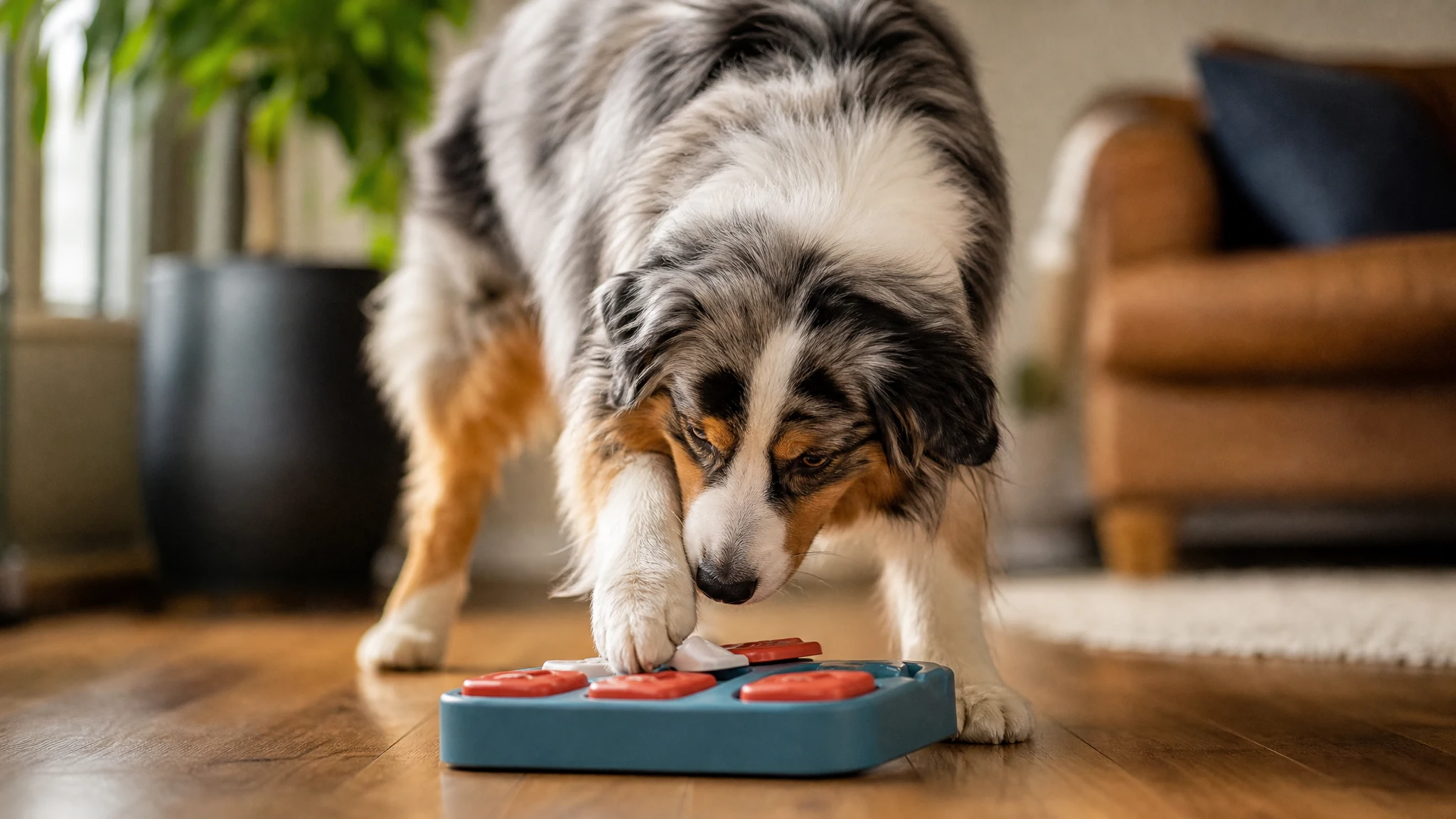
- A puzzle feeder, snuffle mat or lick mat
- A few ordinary household items: cardboard boxes, a muffin tin, tennis balls, towels
- Fresh water, and a plan for rest breaks
- A notebook or phone note to track what your dog enjoys
Step-by-step: building your Aussie's daily plan
Step 1: Start with a veterinary check
Before you build a heavy exercise routine, talk with your veterinarian about your dog's age, weight and joints. This is especially important for puppies and for dogs with any health concerns.
USASA's health program lists hip and elbow evaluation as part of the CHIC requirements for the breed, along with an eye evaluation. It also names hip dysplasia among the health issues it tracks. Only a veterinarian can tell you what your individual dog can handle.
Step 2: Know your dog's life stage
This is where I have to be honest. USASA's published material does not give exercise limits by life stage, and it has no growth or joint-care guidance for puppies. I will not pretend it does.
What it does say is that puppies should stay with littermates until at least 8 weeks and be well socialized. Beyond that, ask your breeder and veterinarian how much running, jumping and stairs are appropriate while your puppy is growing.
As a general habit, many trainers favor short, varied sessions over long repetitive ones for young dogs. Treat that as a conversation starter for your vet, not a rule from the breed club.
For seniors, the same advice applies. Watch for stiffness, slowing down or reluctance, and call your veterinarian rather than guessing.
Step 3: Split the day into several sessions
One big outing is usually less useful than a few smaller ones. A simple pattern:
- Morning: a purposeful walk or active play, followed by breakfast from a puzzle feeder.
- Midday: a short training game or sniff session.
- Evening: a longer outing, then a settling activity such as a lick mat.
Adjust the length of each block to your dog's fitness. Build up gradually. If your dog is panting hard, lagging or seeking shade, end the session and offer water.
Step 4: Add sniff walks
A sniff walk changes the goal. You are not covering distance. You are letting your dog read the neighborhood.
- Clip the long line to a harness and pick a safe, quiet area.
- Stand still and let your dog choose where to investigate.
- Follow at a relaxed pace. Do not hurry the dog along.
- Pause often. Reward calm check-ins with a treat.
Sniffing is mentally tiring work for dogs. Many owners find a slow, sniff-heavy walk leaves their dog more settled than a fast one.
USASA notes that Aussies may be somewhat reserved at first meeting. On busy paths, give your dog space from strangers and reward calm behavior. Never force greetings.
Step 5: Use puzzle feeders and food games
Meals are free brain time. Instead of a bowl, try one of these.
- Puzzle feeder: measure the normal meal portion, then let your dog work for it. Start with an easy setting so your dog wins early.
- Snuffle mat: scatter part of the meal in the folds.
- Muffin tin game: put treats in some cups, cover each cup with a tennis ball, and let your dog figure out which balls to move.
- Cardboard box dig: hide treats in a box of crumpled paper. Supervise so nothing gets swallowed.
Do not add extra food on top of meals without asking your veterinarian how to adjust portions. Use part of the daily ration where you can.
Step 6: Play training games matched to the breed's original job
Herding is about attention, control and quick decisions. You can honor that with games that ask your dog to think and wait, all with rewards.
Find it. Toss a treat on the floor and say "find it." Gradually hide treats around the room, then in other rooms. This builds a search habit and gives your dog a calm outlet.
Hand target. Present your open palm and reward your dog for touching it with their nose. Then move your hand to different spots. This is a handy base for recall, heel work and many tricks.
Stop and go. During a walk or play session, ask for a sit or down, wait a moment, then release with a cheerful cue. Herding breeds often enjoy this start-stop rhythm. It teaches impulse control, which many Aussies need.
Shaping. Pick a simple object, like a towel on the floor. Reward any interest in it, then reward only steps toward it, then paws on it. Let your dog work out what earns the treat. Keep sessions short and end on a win.
Name the toys. Teach your dog the names of two or three toys by saying the name as you hand each one over. Later, ask for one by name. Go slowly.
USASA describes the breed as intelligent and eager to please, and says it is easily trained. Reward-based games use that. For a broader foundation, see our complete guide to training an Australian Shepherd.
Step 7: Channel the herding instinct safely
USASA's buyer checklist tells buyers to discuss the breed's strong herding instinct with the breeder. In pet homes, that instinct can show up as chasing, circling or nipping at moving things.
You can give it a safer outlet.
- Offer a ball or toy that your dog can chase on cue and bring back, with a clear start and stop.
- Reward calm looks at passing bikes, cars or children instead of chasing.
- Practice "leave it" and "down" at a distance from movement, then bring the distance in slowly.
- Keep a long line on until recall is reliable.
Never punish a dog for herding behavior. The instinct is inherited, and punishment can add stress. If chasing or nipping is hard to manage, a qualified reward-based trainer can help.
Step 8: Add real work when you are ready
USASA says it runs AKC sanctioned competitive events, but I could not confirm the specific list. Check the USASA website or the American Kennel Club for current events and requirements near you.
Whatever activity you pick, keep it positive and match it to your dog's age and fitness, with your veterinarian's approval.
Step 9: Teach your dog to switch off
This one gets skipped. An Aussie that is always on can become an Aussie that cannot relax.
- Put a mat or bed in a quiet corner.
- Reward your dog for stepping onto it, then for lying down.
- Add a chew or lick mat.
- Build duration slowly, rewarding calm.
Rest is part of training. A mat habit gives your dog a place to settle on days when the weather or your schedule cuts exercise short.
Sample weekly mix
| Day type | Physical | Mental |
|---|---|---|
| Active day | Longer outing or fetch with start and stop cues | Puzzle feeder breakfast, one training game |
| Sniff day | Slow long-line walk | Find it at home, shaping session |
| Rainy day | Indoor play, stairs only if your vet approves | Muffin tin game, hand targets, mat work |
| Rest day | Short gentle walks | Snuffle mat and lick mat |
Tips for success
- Keep sessions short. Five minutes of focused games often beats a long, sloppy one.
- End while your dog still wants more.
- Rotate toys and puzzles. Novelty keeps them interesting.
- Use part of the daily food ration for training so treats do not add up.
- Watch your dog, not the clock. Panting, slowing or avoiding you means break time.
- Log what works. A short note after each day helps you spot patterns.
Common mistakes to avoid
- Only adding more running. More physical exercise can build fitness without solving boredom. Add brain work before adding miles.
- Skipping rest. An always-excited dog may struggle to settle.
- Overdoing it on a growing puppy. Ask your breeder and veterinarian about limits before long runs or repetitive jumping.
- Rewarding frantic behavior. If you throw the ball every time your dog barks at you, you are teaching barking.
- Ignoring possessiveness. USASA notes the breed can be highly territorial and protective of its owners' possessions. Teach trades, and do not take things away by force.
- Using harsh corrections. The American Veterinary Society of Animal Behavior (AVSAB) recommends reward-based methods. Aversive tools and dominance methods can increase fear and stress.
- Guessing about pain. If your dog limps, resists play or seems off, call your veterinarian.
What to expect
With steady daily activity and mental work, many Aussie owners find their dogs seem more settled at home. You may notice less destructive chewing, less pacing and an easier time relaxing in the evening.
Results vary by dog, age and history, and some behaviors take weeks of practice. If restlessness, barking or chasing continues, talk with your veterinarian to rule out health causes, then consider a reward-based trainer.
A note on health
USASA lists several conditions it tracks in the breed, including drug sensitivity (MDR1), degenerative myelopathy, hereditary cataracts and multifocal retinopathy. Exercise plans do not replace screening or veterinary care. Bring any concerns about your dog's movement, vision or comfort to your veterinarian.
The bottom line
An Australian Shepherd needs a great deal of daily exercise, according to the breed's parent club. Just as important, it needs something to think about. Split the day into several sessions, add sniff walks, feed through puzzles, and play simple training games that echo the breed's working past.
The parent club gives no exact minutes, so build up slowly and check in with your veterinarian. Then add a rest routine so your dog learns that doing nothing is also a good job.