Leash Training a Australian Shepherd: Pulling, Lunging and Loose-Leash Walking
General training information. Every dog is an individual; for health or behavior concerns, see your veterinarian.
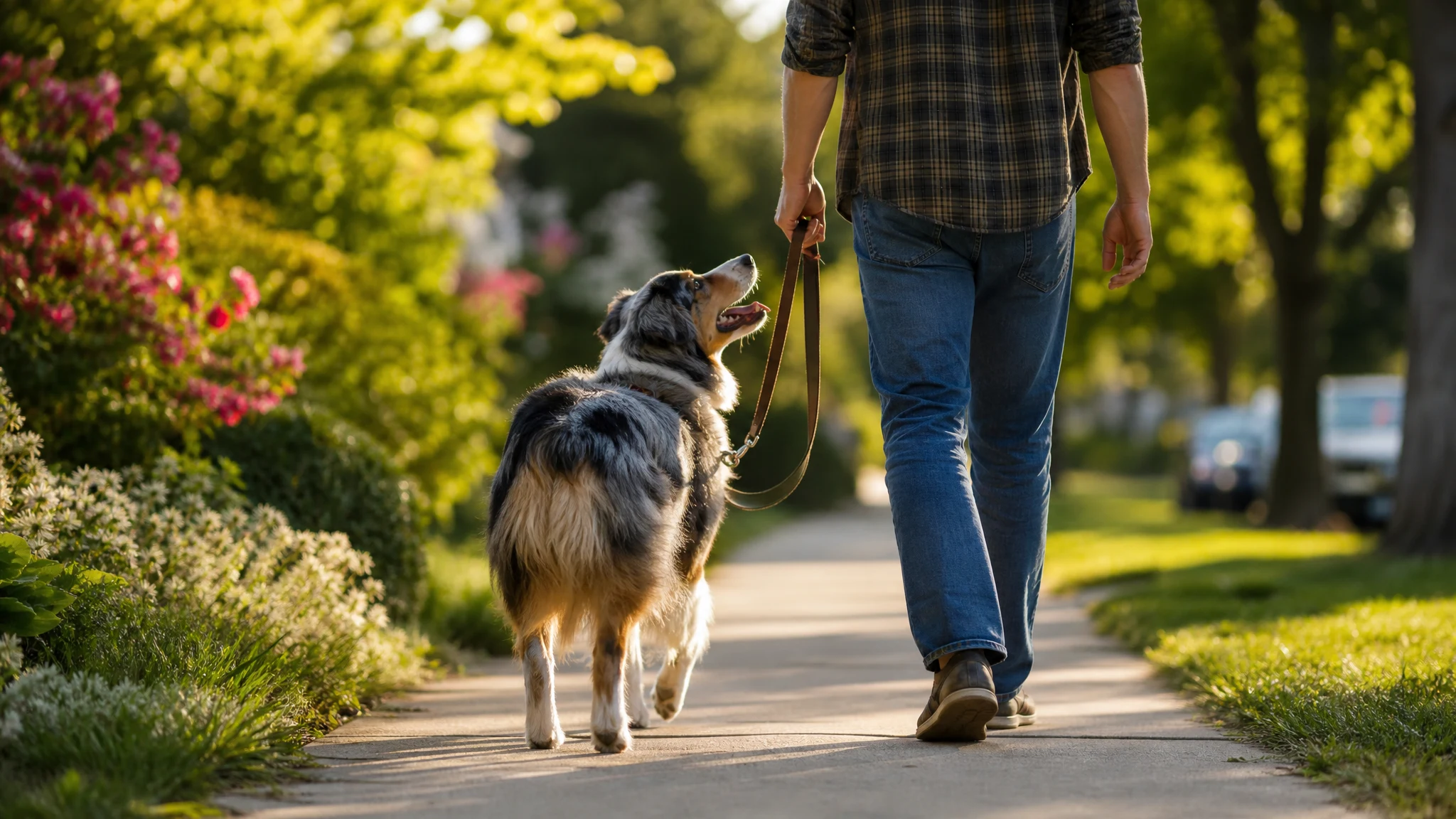
Australian Shepherd leash training starts with a simple fact. This is a working breed, and a walk is not just a bathroom break to an Aussie. It is the most interesting part of the day. Pulling is what happens when a keen, athletic dog has not yet learned that staying close to you is what makes the walk go forward.
This guide shows how to leash train a Australian Shepherd with rewards and patience. You will learn what to buy, how to teach a loose leash in small steps, what to do when your dog lunges, and which mistakes slow people down.
Why Australian Shepherds pull
The United States Australian Shepherd Association (USASA) describes the breed as a versatile farm and ranch dog that works stock. It calls the dog intelligent and active, and it says the breed needs a great deal of daily exercise to avoid boredom or frustration. The breed took its present form in the United States, even though the name points elsewhere.
Put that together and pulling makes sense. A dog bred to be active and alert outdoors will often head for whatever is ahead. Walking at your pace feels slow to such a dog, and every step forward while the leash is tight teaches it that pulling works.
USASA also names a strong herding instinct as something buyers should discuss with the breeder. For leash work, that may show up as intense interest in moving things like bikes, joggers, or skateboards. Individual dogs vary a lot, so watch your own dog and let it tell you what its triggers are.
The parent club also says the breed is easily trained, intelligent and eager to please. That is good news. Your dog wants to work with you. Your job is to make loose-leash walking worth its while.
Materials you will need
- A flat buckle collar with an ID tag. It holds identification, and it is a fine place to clip a leash on a dog that is not yet pulling hard.
- A front-clip harness that fits well, with the leash ring at the chest. It turns the dog slightly toward you when it surges ahead, which can make pulling less rewarding. Fit matters, so check the maker's sizing guide, and ask a veterinarian or a qualified trainer if you are unsure.
- A 4 to 6 foot leash in a comfortable material. Skip retractable leashes for training. They teach the dog that pulling extends the leash.
- Small, soft, high-value treats. Pea-sized pieces work best because you will deliver dozens in a session. Use something your dog loves more than the scenery.
- A treat pouch so rewards are fast and close to your leg.
- A clicker or a marker word such as "yes," if you like marking the exact moment of success.
What not to use: prong collars, choke collars and shock collars. The American Veterinary Society of Animal Behavior (AVSAB) recommends reward-based training and warns that aversive tools can increase fear and stress. They also carry a real risk of harm. An Aussie that learns to expect pain near other dogs or people may become more reactive, not less.
Step-by-step: how to leash train a Australian Shepherd
Step 1: Teach the leash is not scary, indoors first
Clip the leash on inside the house and let your dog drag it for a few minutes while you play or hand out treats. Then pick up the other end and walk around the living room. Reward any moment your dog is near your leg.
Keep sessions to three to five minutes. Aussies are quick, but they also tire mentally. End while your dog is still keen.
Step 2: Reward position near your leg
Pick a side, left or right, and stick with it. Stand still with your dog on that side. The moment it looks at you or stands near your leg, mark and feed the treat right beside your thigh.
Repeat until your dog keeps checking in with you. Then take one step, mark, and reward by your leg. Then two steps. Build slowly. The treat location matters, because the dog learns that the best place in the world is right there next to you.
Step 3: Add the "stop when it tightens" rule
Now you set one clear rule: a tight leash means the walk stops. The second the leash goes taut, stand still like a tree. Do not yank or scold. Wait.
When your dog turns back toward you or the leash goes slack, mark and reward. Then walk on. Your dog learns that slack gets movement and tension gets nothing. This is dull for you at first, but it is the heart of the method.
Step 4: Use direction changes
Aussies are smart and fast, so give them something to think about. When your dog starts to drift ahead, say a cheerful cue, turn the other way, and walk off. When your dog catches up and moves into place, mark and reward.
This keeps your dog watching you instead of the horizon. It also helps an energetic dog burn mental effort, which can take the edge off the pulling.
Step 5: Play loose-leash games
Games make the skill stick. Try these in a quiet yard or an empty parking lot:
- Treat scatter. Toss a few treats on the ground behind you, then walk on. Your dog turns, finds them, and rushes back to you.
- Penalty yards. If the leash goes tight, take three steps backward. Your dog follows, the leash slackens, and you reward and go forward again.
- Red light, green light. Walk fast, stop suddenly, and reward when your dog stops with you.
- Look at that. When your dog notices something interesting, mark the moment it looks at it calmly, then feed. You are teaching it that seeing a thing predicts a treat from you.
Step 6: Take it outside in stages
Start in your driveway, then your quiet street, then busier spots. Each new place is harder, so lower your expectations a little each time and raise your reward rate. If your dog stops responding to treats, you are probably too close to something exciting. Add distance and try again.
Before a walk, give your dog a chance to burn off some energy with play, sniffing or a short fetch session. USASA says this breed needs a great deal of daily exercise, and a dog that has had none is much harder to teach.
Step 7: Reduce the treats slowly
Once your dog walks well for a whole block, start rewarding every second or third good stretch, with the treat timing varied. Keep rewarding often in hard places. Many owners keep a few treats in the pouch for the life of the dog, and that is fine.
Handling lunging at triggers
Lunging is different from ordinary pulling. A dog may lunge at other dogs, people, cars, bikes or animals. The cause can be excitement, frustration at not being able to get close, or fear. Look at the whole body. A loose, wiggly dog is feeling something different from a stiff, staring one.
The USASA breed standard says an Aussie may be somewhat reserved at first meeting, and that shyness, fear or aggression is a fault. It also notes that individual dogs differ. If your dog lunges and growls, or seems frightened, talk with a veterinarian first to rule out pain or illness. A qualified, reward-based trainer or veterinary behaviorist can then help with a plan.
For mild trigger work, these steps help:
- Find your threshold distance. This is how far from the trigger your dog can still notice it and take a treat. It might be 50 feet or more at first.
- Mark and feed when your dog sees the trigger and stays calm. Feed several treats in a row.
- Turn away before your dog explodes. A calm U-turn is a success, not a failure. Reward as you leave.
- Close the distance slowly over many sessions, only as your dog stays relaxed.
- Keep it positive. Never punish a lunge. Punishment can teach a dog that the trigger predicts something bad, which may make the behavior worse.
USASA also notes that Aussies can be highly territorial and protective of their owners' possessions. If your dog guards you on the leash, give it more space from strangers and ask visitors not to approach. A dog that feels it must watch over you will not walk loosely.
Tips for a smoother process
- Train before you are late. Rushed walks mean you tug the leash, and the dog learns tension is normal.
- Keep sessions short and frequent. Five minutes, several times a day, beats one long frustrating session.
- Use sniff breaks as rewards. After a good stretch, say a release word and let your dog sniff. Sniffing is a real job for a dog, and it is a reward you can give for free.
- Be consistent as a family. If one person lets the dog pull, the training takes longer.
- Give the breed a job. USASA lists stock work, guide and service work, and sled work among the things Aussies have done. A dog with enough outlets at home, such as learning new tricks or puzzle feeders, tends to have less pent-up energy on the leash.
Common mistakes to avoid
- Jerking the leash. It hurts, it teaches nothing and it can raise the dog's stress.
- Letting the dog pull "just this once." Every time pulling works, it pays off the habit.
- Going too fast. Jumping from the living room to a busy park sets your dog up to fail.
- Using treats that are too dull. Kibble may not beat a squirrel. Match the reward to the distraction.
- Skipping exercise. A bored, under-exercised Aussie is a hard student. USASA names unmet needs as a frequent reason Aussies are surrendered to rescue groups.
- Yelling or repeating cues. Say it once, then help your dog succeed.
- Ignoring pain. If your dog suddenly begins pulling, lunging or refusing to walk, ask your veterinarian to check it out.
What results to expect
Every dog learns at its own pace. With regular short sessions, many Aussies start to walk beside their handler on a loose leash in quiet places within a few weeks. Busy places and strong triggers usually take longer, and some dogs need months of steady practice.
Adolescent dogs often slip back. That is normal, and going back a step in difficulty usually helps. Progress is rarely a straight line, and no method can promise a particular timeline for your dog.
Your reward for the work is a dog that walks with you instead of dragging you, and walks that feel like teamwork. For the broader picture of raising and training an Aussie, including house manners and early socialization, see our complete guide to training a Australian Shepherd.