Socializing a Australian Shepherd With Kids, Dogs and Strangers
General training information. Every dog is an individual; for health or behavior concerns, see your veterinarian.
Australian Shepherd socialization is about teaching a smart, busy dog that the everyday world is safe and dull. Done well, your Aussie learns to stay calm around children, other dogs and visitors instead of reacting to them.
This guide walks through a plan you can follow at home. It covers what to gather, the steps in order, the mistakes that trip up many owners and what you might reasonably expect.
What the parent club says about temperament
The United States Australian Shepherd Association (USASA) breed standard describes the breed as intelligent and active, with an even disposition. It calls Aussies good natured and seldom quarrelsome. It also says they may be somewhat reserved at first meeting.
That last point matters for this topic. A dog that is a little reserved with new people is within the standard. The same standard says any shyness, fear or aggression is a fault. Good socialization is how you help a reserved dog stay relaxed instead of tipping into worry.
USASA also says the breed is easily trained and eager to please. That works in your favor. But individual dogs vary, so judge your own dog, not a general description.
Are Australian Shepherds good with kids?
It is a fair question, and the honest answer depends on the individual dog, how it was bred and raised, and how the household manages things. This article does not give the breed a blanket rating for children or for other dogs. For breed-wide guidance, check with USASA or a reputable breeder.
What USASA does flag is worth reading closely. The club lists a strong herding instinct and a high activity level among the breed's challenges. It says Aussies can be highly territorial and protective of their owners' possessions. It also names unmet needs as a frequent reason Aussies are surrendered to rescue groups.
For a family, that translates into two jobs. Give the dog plenty of exercise and mental work, and manage how it behaves around children, especially running ones.
Materials you will need
- Small, soft, high-value treats you can break into pea-sized pieces
- A treat pouch or pocket so rewards reach the dog within a second or two
- A standard flat collar or a well-fitted harness, and a six-foot leash
- A baby gate, exercise pen or crate for breaks and separation
- A chew or stuffed toy to keep your dog busy while guests are around
- A calm, vaccinated adult dog friend for practice meetings (ask your veterinarian what is safe for your dog's age and vaccine status)
- A notebook or phone to jot down what went well
Step-by-step socialization plan
Step 1: Start with the right foundation
USASA's buyer checklist asks that a breeder keep a puppy with littermates until at least 8 weeks of age and that the puppy be well socialized. If you are still choosing a puppy, ask the breeder what the pups have already met. Ask too how they have handled herding behavior in the line.
If your dog is older or came from a rescue, the same plan works. Just go slower and let the dog set the pace.
Step 2: Ask your veterinarian about timing
Before taking a young puppy to public places or dog meetings, ask your veterinarian when it is safe for your puppy's vaccine schedule. Your vet can also answer health questions that come up along the way. Until then, you can still do plenty at home with visitors, new sounds and new surfaces.
Step 3: Teach your dog that new things predict treats
Pick a quiet place. Show your dog something mildly new, such as a person walking past at a distance. The moment your dog notices it, say a cheerful marker word like "yes" and feed a treat.
Do this in short sessions of a few minutes. End while your dog is still relaxed. You are building the habit of looking at the new thing, then looking back at you.
For a deeper look at the training basics behind this, see our complete guide to training an Australian Shepherd.
Step 4: Introduce strangers gently
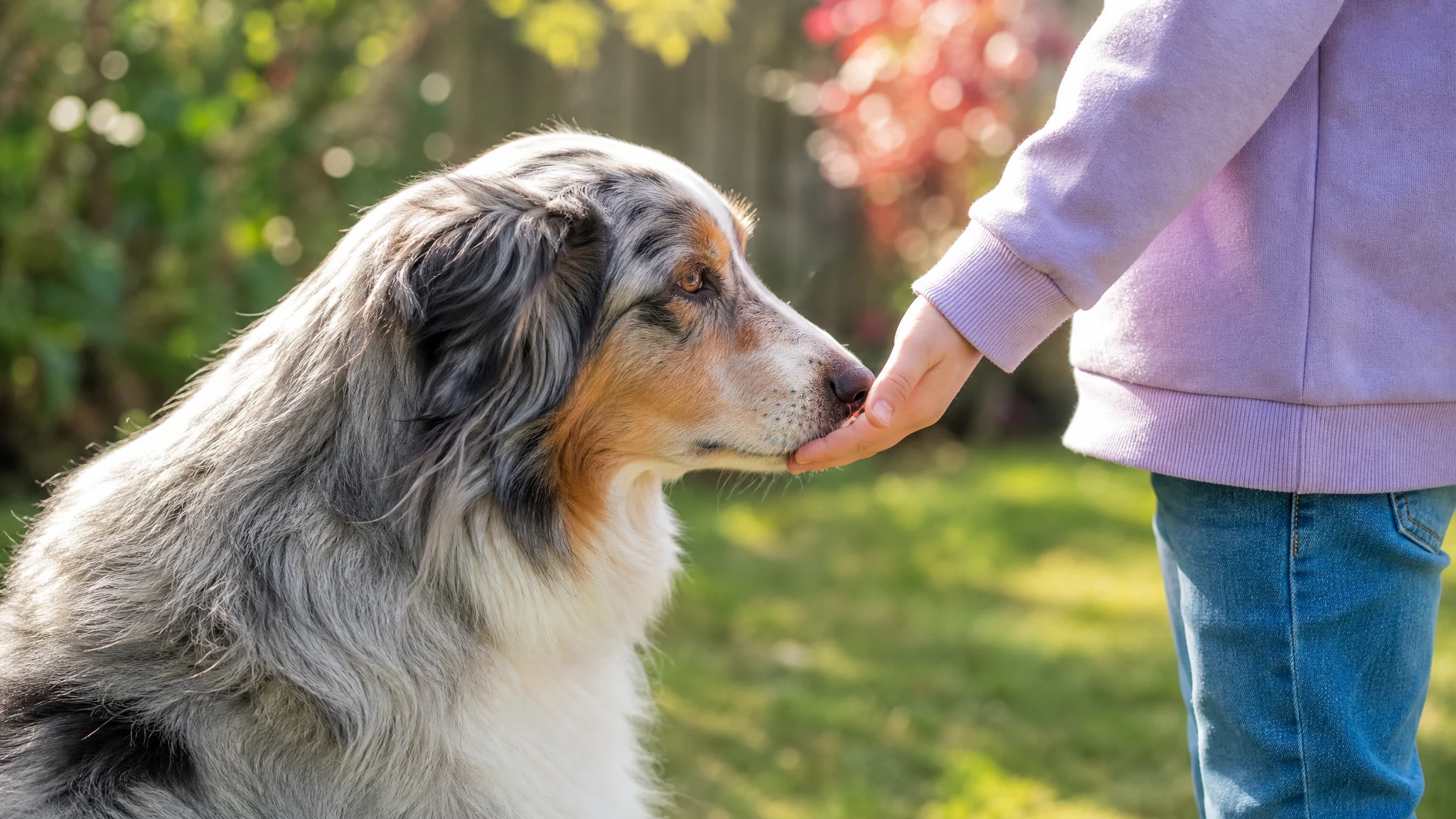
Because Aussies may be reserved at first, do not push your dog toward visitors. Ask people to ignore the dog at first, stand sideways and let your dog choose to approach.
- Have the visitor toss a treat on the floor near them, not at the dog's face.
- Let your dog take the treat and retreat if it wants.
- Only when your dog moves toward the person on its own, allow a brief, gentle pet under the chin or on the chest.
- Ask people not to lean over your dog or grab it.
If your dog freezes, backs away or barks while staying stiff, add distance and try again later. That is information, not stubbornness.
Step 5: Set up safe routines with children
Supervision is the core of this step. Any dog and young child should be watched by an adult who is paying full attention, and separated when that adult cannot watch.
- Teach children to be calm, to stay off the dog's bed and not to hug, climb on or corner the dog.
- Have the child toss treats or hand them out flat-palmed while you control the dog.
- Keep running games away from the dog at first. Fast movement can trigger herding behavior.
- Give the dog a gated area or crate where it can rest without being bothered.
If your dog starts to circle, stare, nip at heels or herd the kids, calmly interrupt the game. Redirect the dog to a toy or a simple cue such as "sit" and reward it. Then give the dog a break. Do not scold a herding dog for acting on instinct. Show it what to do instead.
Step 6: Protect food, toys and favorite spots
USASA says Aussies can be highly territorial and protective of their owners' possessions. Prevent trouble before it starts. Feed the dog away from children, and keep toys and chews your dog values out of reach during play.
Teach children never to take things from the dog. If your dog has something it should not have, trade it for a treat instead of grabbing. If you see stiff body language, growling or guarding, talk to a qualified, reward-based trainer or your veterinarian, and do not punish the growl.
Step 7: Introduce other dogs gradually
When it comes to an Australian Shepherd with other dogs, the first meeting sets the tone. Choose a calm, friendly adult dog and a neutral spot.
- Start by walking the two dogs in parallel at a comfortable distance, with a person between them if needed.
- Reward each dog for staying relaxed and looking at you.
- Close the distance a little at a time over several walks.
- When both dogs look loose and wiggly, allow a short sniff, then call them away after a few seconds.
- Keep first meetings brief and end on a good note.
Watch for herding behavior with other dogs too, such as chasing, circling or nipping at rear legs. Interrupt it early and redirect to a game with you. Dogs that are not a good match for each other do not need to become friends. Calm coexistence is a fine goal.
Step 8: Add variety and keep the dog's life full
Once your dog is comfortable at home, widen the circle with new places, surfaces, sounds and people. Keep each outing short and positive. Many owners also find that daily outlets help, because USASA describes the breed as very active and needing a great deal of daily exercise to avoid boredom or frustration. Walks, games and training sessions all count.
Tips for better results
- Keep sessions short. Five minutes done well beats thirty minutes of struggle.
- Reward calm, not just contact. Pay your dog for relaxed behavior, such as lying down while people walk by.
- Watch body language. Lip licking, yawning, turned heads and tucked tails say your dog wants more space.
- Give jobs. A dog with a task, like fetching a toy or practicing a down-stay, is less likely to invent its own, such as herding the children.
- Practice with different people. Different ages, hats, umbrellas and voices all count as new.
Common mistakes to avoid
- Flooding. Dragging a nervous dog into a crowd or a dog park can make worry worse.
- Forcing greetings. A dog that is reserved with new people should be allowed to choose.
- Leaving kids and dogs unsupervised. Even a well-mannered dog needs an adult watching.
- Punishing warnings. Growls and stiffening are communication. Punishing them can hide the warning, not the feeling.
- Using harsh tools or methods. The American Veterinary Society of Animal Behavior (AVSAB) supports humane, reward-based training. Avoid shock, prong or choke collars, alpha rolls, scruffing and dominance methods. They can raise fear and aggression.
- Skipping exercise. A bored, under-exercised Aussie is more likely to herd, bark or guard.
What to expect
With steady practice, many owners see their Aussie settle faster around visitors, children and other dogs over weeks to months. Results vary by dog, age, background and how consistent the household is.
You might notice your dog looking at you for a treat when something new appears, instead of fixating on it. Greetings may become calmer. Herding urges often do not disappear, but they can be redirected to toys and games.
If your dog shows fear, intense guarding or aggression that does not improve, contact your veterinarian first to rule out health causes. Then ask about a qualified trainer or behavior professional who uses reward-based methods.